
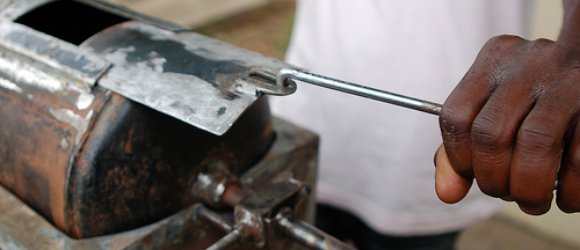
Seems like every week there is some new type of punk steering aesthetics or technology. From punk rock, to post-punk, Cyberpunk, Steampunk, even Biopunk, these gritty ways of life have tried to gain your interest and allegiance. Humblefacture, thought also an ethos which could result in a distinctive styling of product, will hopefully escape the fadish fadings of these movements. But in order to imagine what Humblefacture might become, it might help to compare it to the latest crowd of punks onto the scene -- the Bushpunks.
Showing posts with label humility. Show all posts
Showing posts with label humility. Show all posts

There is a persistent dream (or self delusion) among eco-minded product designers that somehow, manufacturing before the industrial revolution was "better"; Cottage industry was safer, or cleaner, or fairer, or used fewer resources -- or all of the above. Often, this ideal is backed up with anecdotes of textile mills replacing home-spinners, or IKEA replacing cabinet makers. Certainly, these stories of machinery displacing or invalidating jobs (The British still use the mechanistic term "made redundant" to describe layoffs) are true -- but does this mean that a socially sustainable future must involve some return to pre-agricultural cave dwelling? Of course not. But charting a path to such a future requires a re-examination of the human difference between a tool and a machine.

Salon has a great review of Ellen Ruppel Shell's new book Cheap: The High Cost of Discount Culture. The Salon piece, by Stephanie Zacharek, looks particularly at design giant IKEA, and the real costs of using low cost as the metric by which we judge all value in products. IKEA is a good case for exploration, because on the one hand it is so well loved (compared, say, to Walmart), while on the other, it is the largest consumer of timber for furniture in the world, much of it from China. And China has some timber sourcing practices that are dubious, to say the least.
I'm very excited to read the book, because it seems to finally acknowledge that problems like environmental degradation are only symptoms. What is really sick is some more fundamental aspect of our relationship to material goods. As Shell points out in the short promo video for the book, it wasn't so long ago that "cheap" meant something entirely different, both when describing a product, and its purchaser. Many of the goals of Humblefacture will require that products become more expensive than they are now. I don't believe (And I hope the book will help to bear me out) that this higher monetary price will mean that the value of the object won't be worth it. My hope is that for a small increase in monetary cost, we can significantly impact social, environmental, community, and many other costs which don't get figured into IKEA's big blue pricetags.

Wired Magazine had a recent Op-Ed from excellent Human Landscapes blogger and scientist Erle Ellis (he also directs the Laboratory for Anthropogenic Landscape Ecology at the University of Maryland. The article -- "Stop Trying to Save the Planet" -- seems great from the outset, right in line with Humblefacture's ideals, particularly in passages like this one:
And it’s time for a “postnatural” environmentalism. Postnaturalism is not about recycling your garbage, it is about making something good out of grandpa’s garbage and leaving the very best garbage for your grandchildren. Postnaturalism means loving and embracing our human nature, the nature we have created to feed ourselves, the nature we live in. What good is environmentalism if it makes you depressed about the future?However, while this is a big step for the mainstream (is Wired mainstream now?) media to back away from the human vs. nature argument, the author stops short of a truly humble stance.
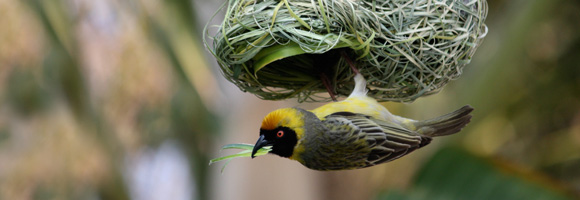
We humans have it pretty good. Blessed by evolution's wheel of fortune with binocular vision, seriously honkin' brains, and opposable thumbs, we've turned ourselves into the uncontested tool leaders of the animal world. Those tools enhance our capabilities more than any claws, fur, or antennae could. We move faster, fly higher, change the courses of rivers and even affect the temperature of the atmosphere. All this can give a mammal a pretty big head -- big enough to think that without us to save it, nature is somehow in danger.

 Posts



